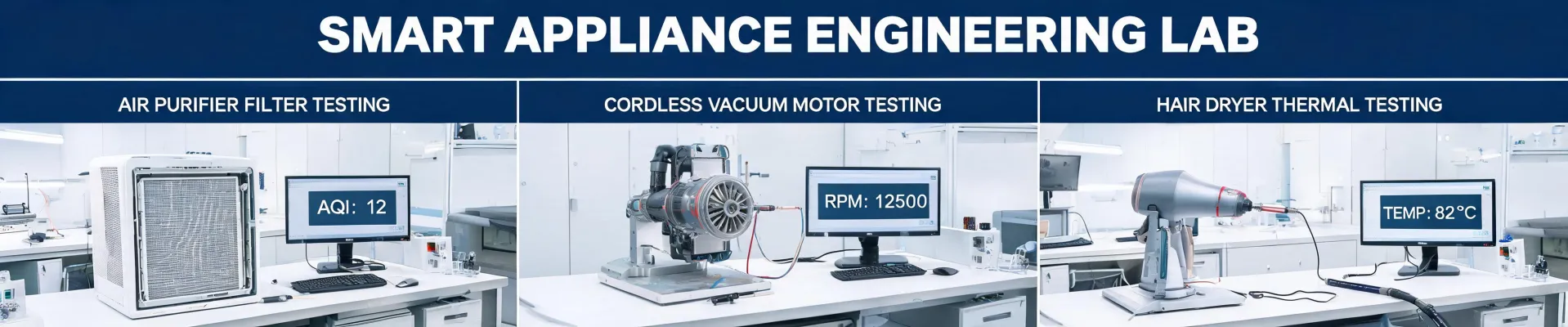
I'm a quality and compliance manager at a regional hospitality group. My team and I review every appliance that goes into our properties—roughly 2,000 items a year, maybe 2,200 if you count the seasonal restocks. I've rejected about 7% of first deliveries in 2025, which is consistent with the past four years. The strange part is that most rejected items look fine. Dents, damage, missing parts—those are easy. What keeps me up at night is what passes the visual check and still fails in service.
Last quarter, one of our properties reported two hair dryers down in under nine weeks. Different floors, different rooms, different users. Same failure point: the motor connector had scorched. The assistant manager asked, "Did we order a bad batch?" That's the surface problem. The deeper issue is that "bad batch" assumes there was a good batch—that the units we received matched the lab-tested unit in the brochure. In my experience, they rarely do.
The Problem You Bring Me Is Usually Not the Real Problem
When I hear "quality issue," I usually hear "I trusted the spec sheet." The spec sheet says the hair dryer has 1875 watts and ionic technology. It doesn't say what happens on the 200th use, or when it runs on a circuit shared with other draws, or when the filter screen picks up eight weeks of hairspray residue. Specs describe a controlled environment. Your building is not a controlled environment.
It's tempting to think that if the specs match, the units will perform the same. But identical specs from different vendors—or even different batches from the same vendor—can produce wildly different outcomes. A spec sheet won't tell you:
- Unit-to-unit consistency. A batch where 3% of units are defective and a batch where 12% are defective can both be "within industry standard." The standard doesn't tell you which one you received.
- Real-world performance. A humidifier rated for 300 square feet might deliver half that after two months in a carpeted bedroom with a closed door.
- Degradation rate. Heating time, suction power, motor noise—these change over time. Specs describe day one.
The frustrating part is that "within industry standard" is a real phrase, and it covers a lot of ground. I've rejected deliveries that a vendor insisted were acceptable. In one case, the vendor was right by the letter of the standard. The unit met the published tolerance—just barely. But "just barely" is not what you want in a $400 appliance.
What Actually Goes Wrong—and Why It's Never on the Brochure
Let's take the question I get asked more often than you'd think: how close should a humidifier be to your bed? The answer is usually about three feet—check your manual for the exact distance—but that's the wrong question. The right question is whether the humidifier can hold its rated output over time. We tested a room unit that claimed 300 square feet of coverage. After two months of normal single-room use, it delivered about 40% of rated output. The filter intake had slowed, the mist was weak, and the room never reached the humidity set point. If the unit underperforms, distance from your bed is irrelevant.
We didn't have a formal first-article inspection process for small appliances until about three years ago. We bought on brand reputation, visual checks, and good intentions. The third time a "good" batch had a defect rate we hadn't budgeted for, I finally created a verification checklist. Should have done it after the first time. The issues we caught after that were almost never visible on the outside.
For instance, a training kitchen specified the blue velvet KitchenAid stand mixer—the colorway was intentional, tied to their branding. The unit passed the out-of-box check: correct model, correct serial range, all accessories present. In the operational test, the head wobbled at speed three. Not enough to fail any published spec, but enough that the premium feel wasn't there. The vendor swapped it. A month later, the replacement had a cracked gear housing. The process cost two weeks of calendar time and a fair amount of trust in that supplier. If I had relied on the spec sheet alone, the original unit would have shipped, and nobody would have noticed until it was in daily use.
My gut said the head wobble was a red flag. The numbers said pass. The gut was right—which is why every verification protocol I write now includes a "does it feel right" step. You can't quantify that on a checklist, but you also can't ignore it.
The Real Cost of "Good Enough"
Here's the part that makes finance people wince. Last year, we saved about $120 per unit—maybe $160, I'd need to check the PO—on a tankless water electric heater for a small guest addition. Yes, a tankless water electric heater. The budget model claimed the same hot water output as the mid-tier unit we usually specify. The spec sheet said both would deliver the same temperature rise at the same flow rate. In practice, the budget unit never got close, even on day one.
Eight months later, both units failed. The first threw an error code that wasn't in the manual. The second leaked and damaged a wall. The total bill was around $2,300 in labor, parts, and drywall—not counting the two nights the room sat empty. Add in guest inconvenience and maintenance overtime, and that $240 in savings cost us more like ten times that. That's the hidden cost of "good enough."
The same logic applies to hair care appliances, which is where Dyson shows up in our orders. I'll be straight with you: I'm not claiming Dyson beats every competitor in every category. To be fair, some premium brands coast on their name. But what I've seen in our testing is that Dyson units tend to perform consistently—the third unit out of the box behaves like the first. When a property specifies the Dyson hair dryer blue variant, I know the internals are the same as the standard model; only the finish is different, and that's a guest-facing detail worth verifying. I check the SKU and the included accessories.
One detail that catches people: the Dyson Airwrap blow dryer attachment. Depending on which Airwrap set you order, the dryer attachment is either in the box or it isn't. Some bundles include it; some don't. We've had a property order a set expecting a standalone dryer, only to realize the bundle didn't include the attachment. Checking the bundle list before unboxing is a five-minute step that prevents a guest-facing headache later.
What Actually Changed in the Industry
What was best practice in 2020 doesn't fully apply in 2025. Budget brands have closed the gap in raw specs, and some premium brands have gotten complacent. The fundamentals haven't changed—you still need to verify—but the execution has transformed. You can no longer assume a known brand delivers a consistent product, and you can't assume a budget brand is a risk. You have to test.
Dyson is also a good example of documentation as a quality signal. They publish detailed performance data on their product pages—airflow, filtration efficiency, decibel ratings, replacement intervals. That matters to me more than marketing language. A brand that documents its products thoroughly is usually a brand that has something to document. And when issues come up, replacement parts are available without a scavenger hunt.
A Verification Habit That Doesn't Take Long
Here's the protocol I use now, and it works for nearly every appliance category:
- Test one unit before you deploy a hundred. It costs one item and an hour of time.
- Run it in conditions close to your real use. If it's a humidifier, run it in a carpeted room for a week. If it's a hair dryer, plug it into the same circuit type your bathrooms use.
- Write down the results. Airflow, temperature rise, noise, wobble—whatever matters. Then hold the vendor to it on the next order.
- Check the fine print. What's the defect tolerance? What's the warranty failure policy? Ask for batch-level data if the vendor can provide it.
Even after we finalized the Dyson order for the renovation, I kept second-guessing whether the blue finish would look right against the vanity fixtures. What if the color didn't match the photos? It was a minor worry, but it didn't go away until the first unit was unpacked and mounted. That's the post-decision part of quality work—you don't fully relax until the product is in use.
A spec sheet is a claim, not a proof. It's a claim about a sample that may or may not be the product you receive. Test the first unit. Inspect the batch. Ask the vendor what their tolerance is—and then ask them to prove it. That's the whole secret. The rest is just checking.